


For e-commerce brands, your products are some of your most valuable digital assets. The product photography, promotional creative, logos and branding used to attract genuine customers can just as easily be copied by scammers and repurposed in fraudulent advertisements.
Rather than building a convincing brand from scratch, scammers can take the trust and recognition a retailer has already established and use it to promote fake discounts, clearance sales and other offers. To the customer scrolling through their feed, the advertisement may look like it came directly from a brand they already know.
The scale of buying and selling scams in Australia shows just how significant the wider problem has become. Between January 2025 and June 2026, Scamwatch recorded 62,895 reports of buying and selling scams, with more than $36.3 million in reported losses. Online was the most commonly reported contact method, accounting for 31,609 reports during the period.
Fraudulent advertising is also operating at significant scale across social media. In 2025, Reuters reported that internal Meta documents estimated users were being shown around 15 billion higher-risk scam advertisements each day across its platforms. The documents described fraudulent e-commerce schemes and impersonation of major consumer brands among the types of abuse appearing across Meta’s services. Meta disputed aspects of the internal estimates, describing some as overly inclusive, while also reporting that it had removed more than 134 million pieces of scam-ad content in 2025.
For e-commerce brands, the problem isn’t just fake websites. Your products, imagery and brand can become the advertising material used to send customers there.
How Fake E-Commerce Ads Work
Fake e-commerce ads are often only the first step in a wider scam. The goal is to create a convincing journey that takes a shopper from a brand or product they recognise to an online environment controlled by the scammer.
The process can look something like this:
01 Copy brand
Logos, product photography, promotional creative and other brand assets are copied from a legitimate retailer.
02 Launch fake ad
The stolen assets are used to create fraudulent advertisements across social media and other advertising channels.
03 Create offer
Large discounts, clearance sales and limited-time promotions are used to attract attention and encourage shoppers to click.
04 Redirect customer
Instead of reaching the retailer's official website, the shopper is directed to a fraudulent website or cloned online store designed to look like the real thing.
05 Monetise scam
From there, scammers may collect payments, personal information or account credentials, sell counterfeit products, or simply take payment for products that never arrive.
What makes this attack chain effective is the use of familiar brand assets throughout the journey. Recognisable products, imagery and branding can make the advertisement appear legitimate, while discounts and promotional offers give shoppers a reason to click. By the time they reach the fraudulent website, they may already believe they’re interacting with the retailer being impersonated.
What Makes Shoppers Click?
A familiar product isn’t the only thing influencing the decision to click. Fake e-commerce ads can combine several trust and persuasion signals that shoppers regularly encounter in real advertising.
| What the shopper sees | What the scammer is exploiting |
|---|---|
| Recognisable product imagery | Product familiarity |
| Official logos and colours | Brand recognition |
| Customer reviews | Social proof |
| Large discounts | Price sensitivity |
| Limited-time offers | Urgency |
| Familiar-looking storefront | Brand trust |
Scam Advertising Is Happening at Scale
Fake advertising is not a new problem, but the volume of scam ads appearing across search engines and social media shows how difficult the problem has become to contain.
In Australia, the ACCC has previously warned that scammers are paying for sponsored advertisements on search engines and social media to impersonate well-known brands. These ads can appear alongside legitimate search results or directly in a consumer’s social media feed, using familiar retailer names and offers to attract clicks.
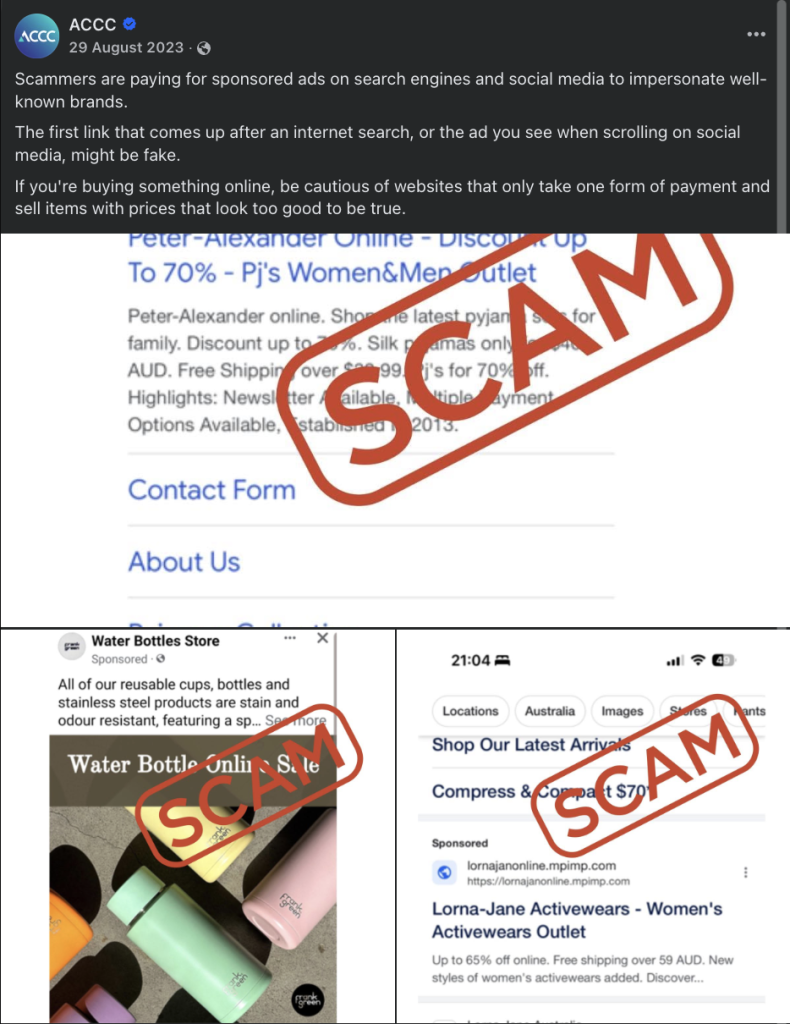
(Example of scam advertisements highlighted by the ACCC. Source: ACCC.)
Victoria Police has also warned that fake ads and classifieds can appear across social media, online marketplaces and other digital channels, often using attractive prices or offers to encourage consumers to engage.
For e-commerce brands, the challenge is that these advertisements can be created and distributed entirely outside the channels they control. A retailer may have no involvement in the ad, the account running it or the website it leads to, despite its products and branding appearing throughout the customer journey.
Even with platforms removing large volumes of scam advertising, new ads, accounts and destination websites can continue to appear. That makes scam advertising an ongoing monitoring problem rather than something brands can rely on platforms or customer reports to identify for them.
Protecting E-Commerce Brands from Fake Ads
For e-commerce brands, protecting customers from fraudulent advertising requires visibility beyond the channels the organisation owns. Fake ads, impersonating social media profiles, lookalike domains and cloned storefronts can all operate entirely outside a brand’s official accounts while still using its name, products and reputation to target customers.
These threats also shouldn’t always be treated as isolated incidents. Multiple advertisements, social media profiles and fraudulent domains may be connected to the same campaign or infrastructure. Identifying those relationships can help organisations understand the wider threat and disrupt more than just the individual ad or website that was initially detected.
Unphish continuously monitors for brand impersonation across paid advertisements, social media, domains, websites, marketplaces and other digital channels. Combined with Campaign Clustering & Intelligence, organisations can identify related threats, investigate the wider campaign and take enforcement action against fraudulent content and infrastructure.
If your products or brand are being used in fraudulent advertisements, contact the Unphish team to learn how we can help detect and disrupt them.