


Australians experiencing financial hardship are increasingly being targeted by scammers impersonating trusted charities offering no-interest loans and low-interest loans.
Rather than offering genuine financial support, these scams are designed to steal money, personal information and government account credentials. Victims may be tricked into paying upfront fees for loans that don’t exist, handing over identity documents, or providing enough information for scammers to gain access to services such as myGov and Centrelink.
According to the National Anti-Scam Centre and Services Australia, scammers are using fake social media profiles and advertisements to lure vulnerable Australians into private conversations before directing them to fraudulent loan application forms.
We Investigated the Scams
A quick search on Facebook uncovered multiple pages promoting no-interest loans and low-interest loans using the branding of trusted Australian charities. At first glance, the pages looked convincing enough. They used copied logos, familiar branding and copied designed graphics promoting legitimate financial assistance programs.

(Fake loan page example 1)
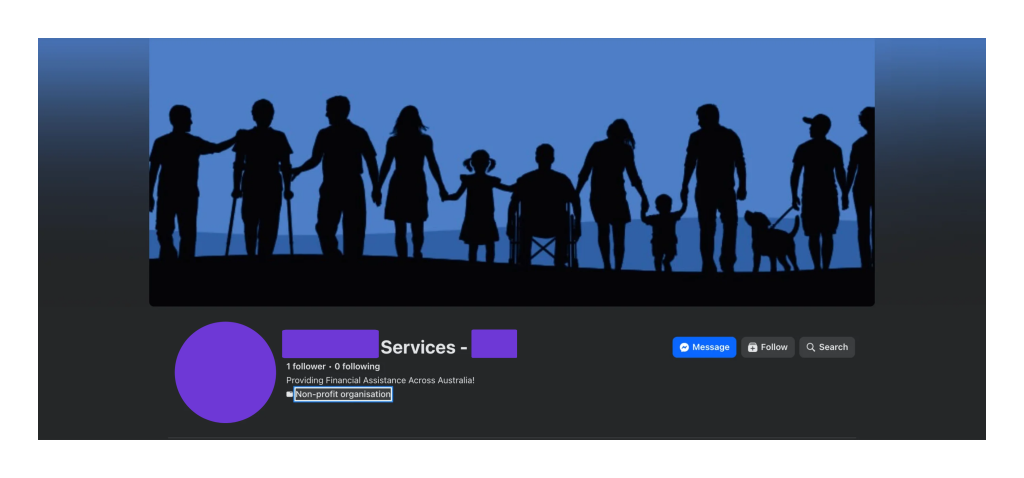
(Fake loan page example 2)
A closer look, however, revealed several warning signs. The pages had only recently been created, had little to no followers or engagement, and described themselves using generic business categories such as “Non-governmental organisation (NGO)” or “Non-profit organisation” in an attempt to appear more real. Their posts were filled with excessive emojis, generic marketing language and broad promises of financial support, many of which appeared AI-generated.
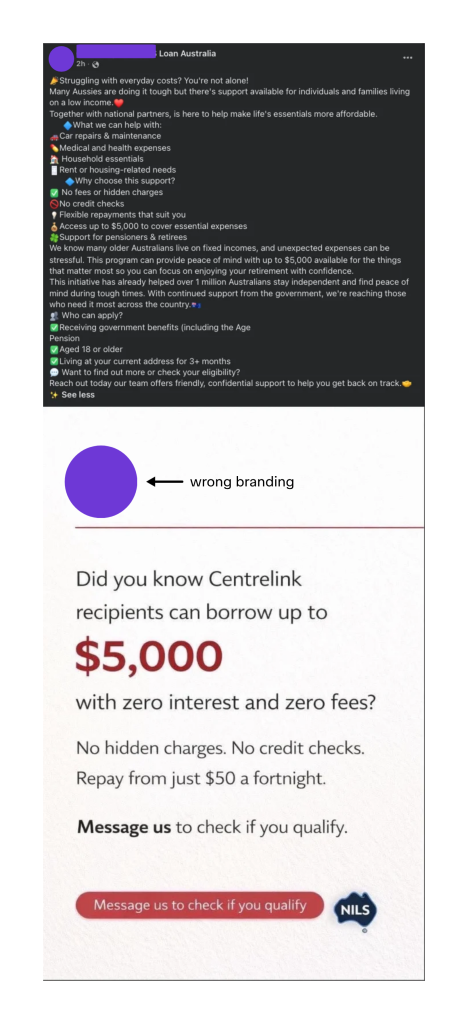
(Example of inconsistent branding and AI-generated content)
In one example, the branding used across the page was inconsistent. The Facebook page impersonated one organisation, while promotional images featured the branding of another trusted charity. Rather than building a convincing online presence over time, these pages appeared to have been created quickly with the sole purpose of encouraging vulnerable Australians to make contact through Facebook Messenger.
The Conversation in Messenger
To better understand how the scam operated, we contacted one of the Facebook pages that were posing as a no interest loans provider.
Within minutes, the account claimed we were eligible for a $5,000 interest-free loan and assured us that the application process was straightforward. Rather than asking us to visit an official website, the entire application was handled through Facebook Messenger.
After confirming we were interested, the account immediately sent us a link to an external loan application form and instructed us to reply “DONE” once it had been completed.
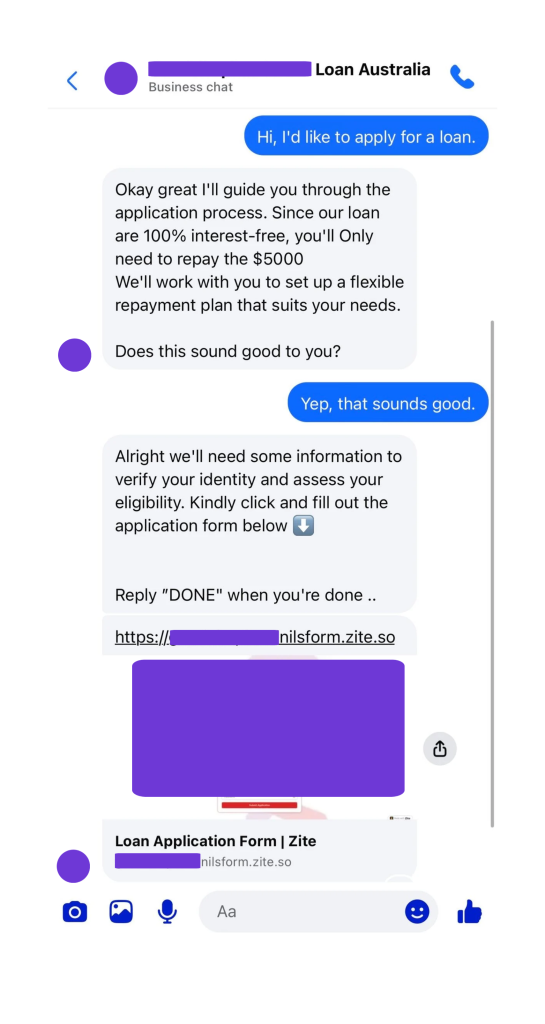
(Conversation in messenger)
If you look closely at the application form’s URL, it isn’t hosted on the charity’s official website. Instead, we were directed to an unfamiliar third-party domain ending in .zite.so. While the beginning of the URL includes the organisation’s name to appear legitimate, it is not the organisation’s official domain. The addition of extra words and the unfamiliar domain extension are some of the clearest indicators that something isn’t right.
The URL is often the biggest giveaway. Scammers can copy logos, colours and branding, but they can’t copy a legitimate organisation’s exact domain name. That’s why it’s extremely important to check the full web address before clicking, not just the first few words.
The account also attempted to move the application entirely outside official channels. Rather than referring applicants to the organisation’s website or a recognised application portal, everything was handled through Facebook Messenger before directing users to an unofficial online form.
Although we chose not to proceed with the application for obvious reasons, the interaction closely matched the warnings issued by Services Australia and the National Anti-Scam Centre. Both agencies warn that scammers often encourage victims to continue conversations through direct messages before requesting sensitive personal information through unofficial forms.
Why These Scams Are So Effective
Unlike many financial scams that promise unrealistic investment returns or easy money, these campaigns target people who are genuinely looking for help. They don’t invent a fake service from scratch. Instead, they impersonate well-known charities and legitimate loan programs that already exist and are trusted by thousands of Australians.
For someone experiencing financial hardship, seeing a familiar charity name alongside an offer of an interest-free loan doesn’t immediately raise suspicion. It feels like exactly the type of support that organisation would provide. The scammers know this. Rather than building trust themselves, they borrow the trust that charities have spent decades earning.
The conversations are also designed to move quickly. Victims are encouraged to continue the application through private messages, where the scammer can collect personal information away from public scrutiny. By the time they are asked for identity documents, banking details or myGov credentials, the victim may already believe they are speaking to a legitimate organisation.
The consequences can extend well beyond a failed loan application. Scammers use the information they collect to steal identities, access government accounts, redirect Centrelink payments, commit fraud, or demand upfront fees for loans that never exist.
What This Means for Charities
These scams don’t just target individuals. They target the trust that charities have spent years, and often decades, building with the communities they support.
When scammers impersonate a charity, the damage extends far beyond financial loss. Supporters and beneficiaries may become hesitant to engage with legitimate programs, genuine applicants may question whether they’re speaking to the real organisation, and staff can be left responding to enquiries about scams they had no involvement in.
These campaigns are also rarely isolated. A single fake Facebook page is often just one part of a broader impersonation campaign that may include additional social media profiles, fraudulent websites, paid advertisements and other online assets designed to reinforce the scam.
This is why monitoring individual incidents isn’t enough. Understanding how these threats are connected helps organisations identify the wider campaign, uncover related infrastructure and disrupt impersonation attempts before they reach more vulnerable people.
Unphish helps charities monitor for brand impersonation across websites, domains, social media and other digital channels. Combined with Campaign Clustering & Intelligence, organisations gain visibility into related threats and can disrupt coordinated campaigns before they cause further harm.
If you’re concerned about brand impersonation or would like to better understand your organisation’s online exposure, contact the Unphish team to learn how we can help protect your brand and the communities you support.